Thatched Cottages of Ireland: Their History, the Craft, and Where to Stay in One

Few buildings say “Ireland” as clearly as a whitewashed cottage under a golden roof of thatch. For generations, thatched cottages were simply how most rural families lived: built by hand from the stone, clay and straw of the surrounding fields, and repaired by neighbours who knew the craft. Today they are among the rarest buildings in the country.

In this guide, we look at where the traditional Irish cottage came from, how thatch is made and maintained, why so many have been lost, and how you can still stay in one. Irish Landmark Trust cares for two restored thatched cottages, Goggin Cottage in Co. Limerick and Killee Cottage in Co. Cork, and every stay helps fund the conservation of buildings like them.

A Short History of Thatched Cottages in Ireland

The thatched cottage is the best-known example of Irish vernacular architecture: buildings shaped by local materials, local skills and local needs rather than by architects or pattern books. Walls were built of rubble stone or mud, bound with lime and clay, and limewashed inside and out. Roofs were framed with whatever timber could be found nearby and covered with straw, reed or rushes.

Dating these houses is difficult, because the way a thatched cottage was built barely changed between the 1700s and the late 1800s. Both of Irish Landmark’s thatched cottages date from around the early nineteenth century, and both appear on the first edition Ordnance Survey maps of the 1840s.

A typical cottage was long and low, one room deep, with the hearth at its heart. The kitchen was the centre of family life, where cooking, work, visiting and music all happened around the fire. A small parlour was kept for important guests, and a bed loft often sat above one end under the thatch. In some houses, the room nearest the stream was once a byre for animals.

These were practical homes, but they were also social ones. At Goggin Cottage, a neighbour remembers the half door “always ajar”, with people dropping in on their way past for tea, news, or to listen to an All-Ireland match on the battery radio before electricity reached rural Ireland.

How an Irish Thatched Cottage Is Built

The Walls and Roof

Beneath the thatch, the structure is simple and clever. At Goggin Cottage, the roof is carried on “A” frame trusses of unsawn local timber, with purlins and small battens that hold the thatch. There are no scraws (the layer of grass sods often laid under thatch); the first layer of thatch goes straight onto the battens, fixed mainly with rope. At Killee Cottage, the walls are local rubble stone and mud, so thick that the front windows have deep seats built into them.

Regional Thatching Styles

Irish thatchers developed different ways of holding a roof together depending on the landscape and the weather:

  • Pinned or scollop thatch was the most widespread method. The thatch is pinned to the roof with scollops, slender rods of bent hazel or willow. A single roof in Co. Cork could need between four and ten thousand of them.
  • Thrust thatch was used across most of Leinster and parts of east Ulster, with bundles of straw thrust tightly into the layer already on the roof.
  • Roped thatch belongs to the exposed Atlantic coast, where thatch is laid over the roof and held down by a network of ropes against the wind.

Straw, Reed and Rushes

In Co. Cork, wheaten straw was the traditional material, with oaten straw used at times. Farmers grew wheat for thatching and cut it by hand with a scythe. When the combine harvester arrived in the 1960s, long unbroken straw became hard to find, and many thatchers moved to water reed.

Reed is well suited to the damp Irish climate. According to Cork County Council’s survey of its thatched houses, a good reed roof can last up to 30 years, though the ridge needs renewing every eight to ten years. Liam Broderick, who re-thatched Killee Cottage, orders Turkish water reed delivered to the port in Cork, and says he can tell how many bundles a job needs just by looking at it. You can read more about his work in Thatching at Killee Cottage.

Why So Few Thatched Cottages Survive

Once the most familiar of Irish cottages, thatched cottages have become rare. In 2022, government figures put the number of thatched buildings remaining in Ireland at an estimated 2,000. Cork County Council found that half of the viable thatched houses it recorded in the 1980s had deteriorated or lost their thatch by 2001.

The reasons are familiar to anyone who cares for old buildings:

  • Empty houses decay quickly. When the last occupant dies or moves out, a cottage can be left empty while a new house is built beside it. As Liam Broderick puts it, it is not long before “the roof dies too”.
  • The craft is fading. There are few thatchers left, and few young people training in the trade.
  • Insurance is hard to find. Owners of thatched homes have struggled to get affordable cover, a problem that grew after Brexit made it harder for specialist London underwriters to offer cover here.
  • Materials changed. Mechanised farming ended the supply of long, hand-cut straw.

Goggin Cottage shows how close a building can come to being lost. The cottage had no electricity or running water when Irish Landmark Trust began work in 2009, re-thatching the roof over the winter of 2009 to 2010. Funding ran out in 2012 and work stopped. In 2017, vandals broke in and destroyed original joinery, including the narrow loft staircase. The project only restarted in 2021 with funding from the Heritage Council, when thatcher Tómas Collins replaced the failing ridge. You can follow the full story in the Goggin Cottage restoration and the lime work carried out on its walls.

Stay in a Thatched Cottage With Irish Landmark Trust

The best way to understand a thatched cottage is to spend a few nights in one: to light the fire, listen to the rain on the thatch, and duck under a doorway built for another century. Irish Landmark’s properties are WiFi and television free, so the pace of the stay is yours to set.

Goggin Cottage, Kildimo, Co. Limerick

Goggin Cottage is an early nineteenth century, three-roomed thatched cottage that stayed in the Goggin family from the day it was built until Jack Goggin, its last occupant, left in the late 1990s. The 1901 census records five people living here, including John Goggin, a 79-year-old farmer, and his granddaughter Mary. Today, the original crane is back in the open hearth, layers of limewash tinted with red madder have been left visible on the walls, and a hand-built staircase leads to a loft bedroom for children.

It sleeps up to four, welcomes up to two dogs, and makes a good base for Adare, Curraghchase Forest Park and the Shannon Estuary. Read The History of Goggin Cottage or plan a week with our guide to 7 Nights in Goggin Cottage.

Killee Cottage, near Mitchelstown, Co. Cork

Killee Cottage sits at the foot of the Galtee Mountains in the Golden Vale. It was once one of several cottages along a quiet lane known locally as The Mall, and it is now one of only two thatched cottages left there. Probably built as a one- or two-room labourer’s dwelling tied to the Montgomery Estate, it dates from the early nineteenth century or even the late eighteenth. During restoration, the hearth was opened back up to its original size, revealing the original bressumer beam still in place.

Killee sleeps two and welcomes one dog, which makes it a natural choice for a romantic break or a walking holiday. Our guide to Killee Cottage includes a seven-day itinerary for the area.

Give a Stay, or Help Save the Next One

Irish Landmark Trust is a not-for-profit charity. Every booking helps maintain the buildings in our care, and donations fund the next rescue. If you would like to share the experience, an Irish Landmark gift card makes a thoughtful present for anyone who loves history and quiet places. And if you would like to help keep Ireland’s vernacular buildings standing, you can support our conservation work.

Frequently Asked Questions

How many thatched cottages are left in Ireland?

In 2022, government figures estimated that around 2,000 thatched buildings remained in Ireland, a small fraction of the number that once stood across the countryside.

Can you stay in a thatched cottage in Ireland?

Yes. Irish Landmark Trust has two restored thatched cottages available for self-catering stays: Goggin Cottage in Co. Limerick, which sleeps up to four, and Killee Cottage in Co. Cork, which sleeps two. Both are dog-friendly.

Are thatched cottages warm?

Thick stone walls and a deep layer of thatch hold heat well, and both of our cottages have modern heating alongside a wood-burning stove. Goggin Cottage has underfloor heating, and Killee Cottage has oil heating.

How long does a thatched roof last?

It depends on the material and the location. A good water reed roof can last up to 30 years, while traditional wheaten straw lasted about 20. The ridge usually needs renewing every eight to ten years.

Why are thatched cottages disappearing in Ireland?

Many were left empty when families built new homes beside them, and an empty cottage decays quickly. Fewer thatchers are working today, traditional straw is harder to source, and owners often struggle to find affordable insurance.

Plan Your Stay

Whether you are drawn by the history, the craft or the chance to switch off for a few days, a thatched cottage is one of the most memorable places to stay in Ireland. Browse all Irish Landmark properties or go straight to Goggin Cottage and Killee Cottage to check availability.
Featured Property

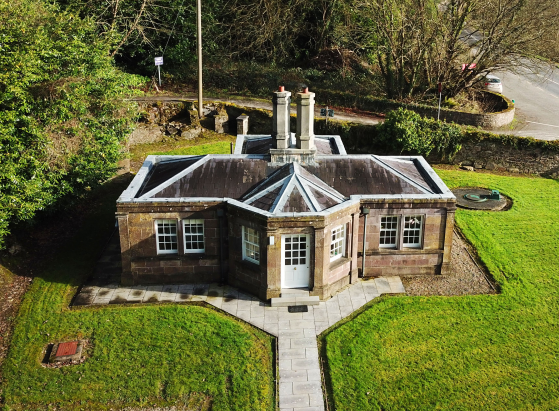
Salterbridge Gatelodge

Salterbridge Gatelodge, located in the glorious Blackwater valley, dates from the mid 19th Century.

View Property

Sign up to our
mailing list

Get the latest news, exclusive deals, and more from Irish Landmark.

Name(Required)
Enter your name
This field is for validation purposes and should be left unchanged.

Booking Conditions

HOW TO BOOK AN IRISH LANDMARK HOLIDAY : 

It is possible to reserve dates online at www.irishlandmark.com but bookings are not confirmed until a confirmation email is received from the bookings desk.     

BOOKING:  

Your booking must be for holiday purposes only.  Irish Landmark reserve the right to refuse hire for purposes other than holiday accommodation. When you make a booking, you accept full responsibility for all persons who will use or visit the property during the period booked.  When you book, you agree to indemnify us against all loss and damage arising directly or indirectly to the property and its contents from any deliberate or negligent act or omission by yourself, or any person accompanying you. 

CONTRACT OF HIRE:  

The hiring contract shall be between the Hirer and Irish Landmark and made subject to these Booking Conditions . The Contract of Hire is not effective until Irish Landmark dispatches to the Hirer written confirmation of a booking. 

PRICE OF YOUR HOLIDAY:   

Irish Landmark reserves the right to increase or decrease the price of unsold holidays at any time. However, such amendments to price will not be applied to holidays already confirmed.   

V.A.T.:  

All prices quoted are based on current prices and rates of V.A.T. at the time of going to press. Irish Landmark is unable to absorb increases in Value Added Tax or any new forms of taxation which may be introduced. Any such increases will be charged as notified and will be payable. 

DEPOSIT AND BALANCE PAYMENTS:   

All bookings can be paid for in full at time of booking. All bookings made within 12 weeks of stay must be paid in full at time of booking. Bookings made more than 12 weeks in advance of stay require a 30% non-refundable deposit with the balance due 12 weeks before arrival.  Irish Landmark shall be entitled to treat any failure to pay by the due date as a cancellation of the booking and will notify the Hirer by email.  The maximum number of payments for a booking will be limited to two – the deposit and balance payment.   A separate payment may be due where an amendment has been made to the original booking.  

PAYMENT TYPES: 

Payments can be made by credit/debit card (Visa or Mastercard ONLY).    

Payments for properties in the Republic of Ireland are taken in Euros, payments for properties in Northern Ireland are taken in Great British Pounds. 

VOUCHERS:  

Please note that only one voucher can be used per booking.  Vouchers have a strict expiry date. 

CONFIRMATION OF BOOKING:    

Upon receipt of payment by our bookings office, you will receive a confirmation of your reservation.  All charges for the booking will be confirmed in this notification.  Once confirmation has been issued, the Hirer is responsible for the total advertised price of the property and any extras notified.   

AMENDMENTS TO BOOKINGS (excluding cancellations):    

Irish Landmark does not offer a transfer of dates option. A complete change of dates is treated as a cancellation 

CANCELLATION POLICY: We hope that you will not have to cancel your stay, or part of your reservation.  If for any reason this is unavoidable, cancellations must be notified by email to bookings@irishlandmark.com. In the event of cancellation (this includes a reduction in number of nights) your deposit is non-refundable and the following cancellation charges will apply:  

Date of Cancellation 

Cancellation Charge 

More than 12 weeks before start date 

The deposit of 30% 

84 – 28 days before start date 

50% of total rental 

Fewer than 28 days 

100% of total rental 

Irish Landmark does not operate a cancellation insurance scheme for any reason, including Covid-19, and strongly recommends that all guests take out full holiday insurance cover.    

PARTY SIZE AND COMPOSITION:  In no circumstances may more than the number of persons listed on the booking form occupy the property overnight.   Irish Landmark reserves the right to refuse admission if this condition is not observed. Bookings can only be made by adults and cannot be accepted from anyone under the age of 21.  Irish Landmark only allows guest stays where the lead guest is aged 21 years or over.   

ARRIVAL AND DEPARTURE:  

Upon receipt of final payment, you will receive Access Details and Important Information via email about your rental. This includes the contact information of the Local House Manager, directions to the property, arrival and departure time, etc. However, the specific arrival time must be agreed with the relevant local House Manager at least four days prior to holiday start date.  It is the responsibility of the Hirer to arrive at the property at the time agreed with the House Manager. Irish Landmark reserves the right to levy an additional charge if the property is not vacated in accordance with these terms on the day of departure.  

DAY VISITORS:  

The number of day visitors will be limited to the capacity of the property – i.e., a 2-person property may have 2 day visitors, etc.   Prior written consent must be obtained from Irish Landmark Trust for additional numbers of day visitors. 

PERSONAL BELONGINGS: Baggage and personal belongings are always at the Hirers risk. No responsibility can be accepted for loss or damage to any car or its contents. 

POLICY REGARDING DOGS:   

Only certain Irish Landmark Trust properties accept a dog.  ALWAYS check this before you book.  Hirers who have made a reservation and are taking a dog will be required to read and agree to special terms, which details the conditions of bringing a dog to one of these properties.  Failure to comply with these conditions could result in the guest being asked to leave a property.  The rental cost is non-refundable in such cases.   

ELECTRIC VEHICLES: 

Irish Landmark respectfully request that you charge your electric vehicle at the nearest charging point and not at the property.  

HIRER’S RESPONSIBILITY:   

The Hirer is responsible for the property and is expected to take all reasonable care of it. Our House Managers work hard to maintain and clean the buildings and aim to ensure that the property is in a satisfactory condition for your enjoyment.  We ask that you leave the property in a clean and tidy condition upon departure, including all equipment, utensils etc. If the property is left in an unsatisfactory condition and additional cleaning costs are incurred, Irish Landmark reserves the right to recover these costs from the Hirer.   All breakages and damage must be reported to the House Manager immediately so that they can be rectified. All breakages and damage are the legal responsibility of the Hirer and the cost of repair or replacement must be paid to Irish Landmark upon demand.   If there are problems relating to the functioning of the building, please let the House Manager know immediately. Please note that candles are NOT permitted at any Irish Landmark property. Smoking is not allowed inside any Irish Landmark property. 

WEBSITE / LITERATURE:   

While every effort has been made to ensure that the representations stated on our website, or any printed literature, are made in good faith, neither they nor any oral representations made by employees or representatives of Irish Landmark Trust will create liability on the part of Irish Landmark. 

GENERAL:   

There shall be no liability for any claim arising from the act, omission or neglect or default of Irish Landmark Trust, its employees or representatives unless proved to be done with intent to cause damage or recklessly and with knowledge that loss or danger would probably result. Irish Landmark’s agents, servants and employees or other representatives have no authority to waive or modify these Conditions other than in writing. 

RIGHT OF ENTRY:   

On rare occasions Irish Landmark may need access to the property for essential maintenance work, should it be necessary, Irish Landmark will give you as much notice as is possible.   There is no need for you to stay in the property since our House Manager can accompany any such visits. 

COMPLAINTS:  

If you have any complaint during your holiday, please contact the House Manager.  If the matter is not dealt with to your satisfaction, please email bookings@irishlandmark.com outlining details of your complaint.   

IRISH LANDMARK’S RIGHTS:   

Irish Landmark reserves the right to refuse any booking and cancel any booking already made, if in its absolute discretion it considers this to be necessary. Where a booking is cancelled by Irish Landmark, every effort will be made to offer an alternative holiday at no increase in cost.  If the Hirer does not accept the alternative holiday offered, Irish Landmark will return to the Hirer the deposit paid and any other sum paid to Irish Landmark by the Hirer.  Liability for all consequential loss, damage and disappointments is accordingly limited to such return. 

SPECIAL CONDITIONS FOR SPECIFIC DOG – FRIENDLY PROPERTIES 

It is the hirer’s responsibility to ensure they book a specific dog-friendly property if they are bringing a dog.  There are specific terms and conditions that to which the hirer must adhere: 

We allow a dog, but only when they have been booked in and paid for. The “Taking a Dog” option must be selected at time of booking.  A charge will apply.  

Our policy is strictly ONE DOG. If you arrive at the property with more than one dog the House Manger is entitled to deny you access to the property.  If it becomes known during/after your stay that more than one dog is/was with you, you may be asked to vacate the property and a charge of €100/£100 per dog will apply. 

You must bring your own crate/bed in which your dog can sleep.  Please also bring bowls, towels, and waste bags for your dog. 

Your dog must be house-trained and kept under proper control.  Dogs are STRICTLY not permitted on beds, sofas, or any furniture.  There is no exception to this rule.  

Before departure, please thoroughly clean the property, paying particular attention to removing pet hair from rugs and soft furnishings.  A vacuum cleaner is available to you.   

If there is evidence that you have not cleaned up adequately after your stay, you will be charged a flat rate of €100/£100.   

You must double-check that the outside area around the property is free of any foul. Dog fouling inside the property is completely unacceptable.  Guests will be asked to vacate the premises immediately if this is discovered.  

Your dog must not be left unsupervised in the property.  We ask that you take your dog with you when you go out.  Please be mindful of any livestock nearby. 


By accepting a confirmation of a reservation from Irish Landmark the lead guest agrees: 


I have read and agree to be bound by the Booking Conditions. 

I agree to be held responsible for the balance of hire for the property due and payable in accordance with these terms. 

I understand that most Irish Landmark properties have no television or internet access; that some have no washing machines or dishwashers; and that many have limited mobile phone coverage. 

I understand that as the Lead Person, I am responsible, before their arrival, for informing all guests of Irish Landmark’s booking conditions, and for their observance of same. 

If I am bringing a pet or having day visitors, I have particularly noted the special conditions that apply in these situations 


Hirers making a reservation over the telephone are deemed to have read all Booking Conditions and agree to be bound by them.   


Availability Calendar

Check availability for all of our properties at a glance here.

Northern Ireland
Loading...
Republic of Ireland
Loading…

Important Notes

1-night stays are not permitted.

Bank Holidays & Special Dates have a set minimum number of nights.

Terms and Conditions apply to all bookings.

Special Offers and Discounts are not valid against existing bookings.

There are restrictions on arrival and departure dates over the Christmas and New Year periods.
Strictly no arrivals or departures on 24th, 25th and 31st of December, or 1st of January.